Sunday, 9 February 2014

Chapter 8: Accessing Organizational Information – Data Warehouse


“Even a rock moves on.”
Anthony Liccione


so what are we waiting for ? lets move forward to our next chapter which is


CHAPTER



Accessing Organizational Information  – Data Warehouse

  1. Data Warehouse Fundamentals:
    - data warehouse :

    * a logical collection of information 
    * gathered from many different operational databases* supports business analysis activities and decision-making tasks * The primary purpose of a data warehouse is to aggregate information throughout an organization into a single repository for decision-making purposes
         - extraction, transformation, and loading (ETL) :
        * a process that extracts information from internal and external databases
       
* transforms the information using a common set of enterprise definitions
        * loads the information into a data warehouse
         - data mart :
        *
contains a subset of data warehouse information


 example of ETL :


 2. Multidimensional Analysis and Data Mining:
      - Cube :
   
     *
common term for the representation of multidimensional information


     - data mining

       * process of analyzing data to extract information not offered by the raw data alone
    - data mining tools :
       * a variety of techniques to find patterns and relationships in large volumes of information and infer rules from them that predict future behavior and guide decision making


3.  Information Cleansing or Scrubbing :

      - process that weeds out and fixes or discards inconsistent, incorrect, or incomplete information

4.  Business Intelligence :

     - applications and technologies that are used to gather, provide access to, and analyze data and information to support decision-making efforts

  Principle BI enablers include

    * Technology
    
* People    * Culture


example of business intelligence : 


감사합니다
σας ευχαριστώ
gratias tibi,
ขอขอบคุณคุณ
thank you
terima kasih


Sunday, 2 February 2014

Chapter 7 : Storing Organizational Information- Databases


moving to this chapter 7, 
holla, hye and assalamualiakum :) meet me again in this 7th's chapter !

quote for today that i want to share is 
 "Try not to become a man of success, but rather try to become a man of value."
Albert Einstein 
so, that the quote for today, to be a man value, lets start studying, because a person without knowledge is nobody because everything need knowledge in this 20th century.


Relational Database Fundamentals :

  • Hierarchical database model - information is organized into a tree-like structure that allows repeating information using parents or child relationship in such a way that it cannot have too many relationship. It will were widely used in the first mainframe databases managements systems. 
  • Network database model - is a flexibility way of representing objects and their relationship. 
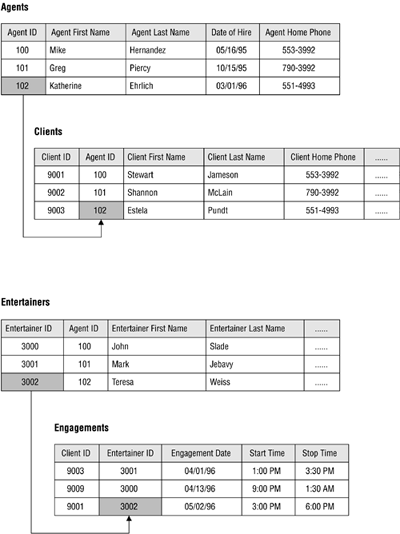
  • Relational databases model - is a type of databases that store information in the form of logically related two dimensional tablesTwo dimensional means that in one web or network we can know many things in many way not just focus in one section. For example, Facebook social network is not focus only in one function but in Facebook if we click in other function the pages will proceed to other function in the same time without need to open new tab.

below are the illustration of above database :
network database model
relational database model
Entities And Attributes :

  •    Entity – a person, place, thing, transaction, or event about which information is stored    - The rows in each table contains the entities
  •  Attributes (fields, columns) – characteristics or properties of an entity class- The columns in each table contain the attributes


Key and Relationship :

  • Primary key – a field (or group of fields) that uniquely identifies a given entity in a table
  • Foreign key – a primary key of one table that appears an attribute in another table and acts to provide a logical relationship among the two tables


Relational Database Advantages :

  • Database advantages from a business perspective include
    –     Increased flexibility–     Increased scalability and performance–     Reduced information redundancy–     Increased information integrity (quality)–     Increased information security
Database Management System :
  • Database management systems (DBMS) 
    – software through which users and application programs interact with a database


Data-Driven Web Site Business Advantages :

  • the advantages of data-driven web site business are as below-  Development
    - Content management
    - Future expandability
    - Minimizing human error
    - Cutting production and update costs


Example Of Business Intelligence : 


business intelligence in data-driven websites

                                                     
thank you, till we meet again :)
xoxo :D


Wednesday, 15 January 2014

Project Focus :)

Norzulaiha Bt. Alias
Noor Asniza Bt. Asmaddin
Ayuliza Bt. Kasim
Nurul Aisyah Bt. Ahmanul
Nur Atila Bt. Abdul Rahman
Putri Azizuhainee Bt. Mohd. Khalid
 
Question :
We know that people use information technology to work with information. Knowing this, how could these types of errors occur? What could happen if you decided to use Facebook to collect information intelligence for a research paper? What could Facebook do to help prevent these types of errors?
 
Here are some references to determine whether the information obtain is a good or bad; 


Problems that may occur:
 
Facebook is a website that is generally open to all.  The information can be easily falsify and does not need to be filtered. Thus, why the information is not credible for the use of a research. The information obtain may not be true or valid and may not be based on facts. Furthermore, the information at facebook may be biased as it is based on ones opinion and perception. Lastly, we have no way to insure that the information that is posted on facebook is valid as for we do not know the sources of information and its credibility.
 
Prevention that Facebook may do to prevent these problems:
Facebook should filter the information posted on their website or increase its security by valuating its information and sources.


Monday, 13 January 2014

Chapter 6 : Valuing Organizational Information


"Living in dreams of yesterday, we find ourselves still dreaming of impossible future conquests."
Charles Lindbergh 

"stop dreaming and lets move forward"
 me, 2014 :)


ermm its just in a few week and now we are in the new chapter which is chapter 6, which discussing about; Valuing Organizational Information.

1st of all we will discuss about organizational information. What is organizational information ? this diagram might make us clear about it :)


next, the diagram below shows the comparison between the value of transaction and analytical information.
we also need to know about values of quality information. Example for quality informations are:


on the other hand, the four primary sources of low quality information that we should know are:
  • Online customers intentionally enter inaccurate information to protect their privacy.
  • Different systems have different infomartion entry standards and formats.
  • Call center operators enter abbreviated or erroneous information by accident or to save time.
  • Third-party and external information contains inconsistencies, inaccuracies, and errors.

last but not least, in this chapter we have to understanding the cost of poor information. The example are as below :

  • Inability to accurately track customers, which directly affects strategic initiatives such as CRM and SCM.
  • Difficulty identifying the organization's most valuable customers.
  • Inability to identify selling opportunities and wasted revenue from marketing to nonexisting customers and nondeliverable mail.
  • Difficulty tracking revenue because of inaccurate invoices.
  • Inability to built strong relationship with customers-which increases buyer power.


Sunday, 12 January 2014

Chapter 5: Organizational Structures That Support Strategic Initiatives


Lets discover our next chapter which is chapter 5 "Organizational Structures That Support Strategic Initiatives" 


In this chapter it is important to understand the duties of roles of   CIO,  CTO, CSO, CPO,  CKO, The gap between business personnel and IT personnel, and Organizational fundamentals - ethics and security.


The Responsibility of CIO, CTO, CSO, CPO, and CKO :
  • Chief information officer (CIO) - responsible for overseeing all uses of information technology and ensuring the strategic alignment of IT with business goals and objectives
    1. Manager - ensure the delivery of all IT projects on time and within the budget
    2. Leader - ensure the strategic vision of IT is in line with the strategic vision of the organization
    3. Communicator - advocate and communication that IT strategy by building and maintaining strong executive relationships
  • Chief technology officer (CTO) - ensuring the throughout,speed, accuracy, availability,and reliability of an organization's information technology
  • Chief security officer (CSO) - ensuring the securities of IT systems and developing strategies and IT safeguards against attacks from hackers and viruses
  • Chief privacy officer (CPO) - ensuring the ethical and legal use of information within an organization
  • Chief knowledge officer (CKO) - responsible to collect, maintain and distribute the organization's knowledge


The Gap Between Business Personnel and IT Personnel
  • Business personnel - posses expertise in functional areas such as marketing, accounting, sales, and so forth
  • IT personnel - the technological expertise


Organizational Fundamentals - Ethics and Security

1.    Ethics - the principles and standards that guide our behaviour toward other people
2.   Privacy - right to be left alone when you want to be, to have control over your own personal possessions, and not to be observed without your consent


that all for this chapter! see you soon 


xoxo :D 

Chapter 4: Measuring The Success Of Strategic Initiative


   hyeee :)  now we meet again to discuss about this chapter 4. Chapter 4 is about  measuring the success of strategic initiative. What is all about ?

there are a few important point in these chapter which is :


 a) MEASURING INFORMATION TECHNOLOGY’S SUCCESS ;

  1.           Key performance indicator is a measures that are tied to business drivers
  2.           Metrics are detailed measures that feed KPIs
  3.           Performance metrics fall into the nebulous area of business intelligence that is neither technology, nor business centered, but requires input from both IT and business professionals


b)  EFFICIENCY AND EFFECTIVENESS


    1.         Efficiency IT metric – measures the performance of the IT system itself including throughput, speed, and availability
    2.         Effectiveness IT metric – measures the impact IT has on business processes and activities including customer satisfaction, conversion rates, and sell-through increases
Common types of efficiency IT metrics


Common types of effectiveness IT metrics


c)  METRICS FOR STRATEGIC INITIATIVES
·         Website metrics.

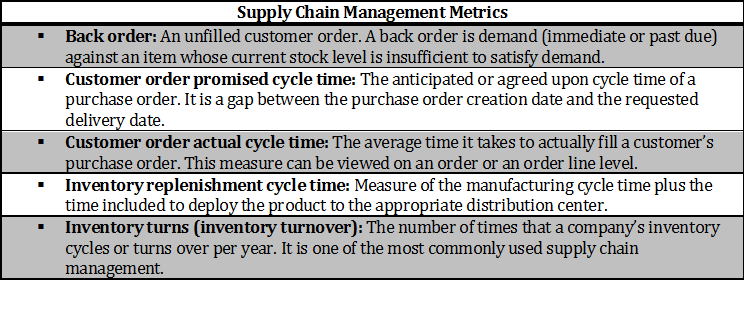
·         Supply chain management (SCM) metrics

·         Customer relationship management (CRM) metrics

·         Business process reengineering (BPR) metrics and Enterprise resource planning (ERP) metrics 


** Balanced scorecard- a management system, in addition to a measurement system, that enables                 organizations to clarify their vision and strategy and translate them into action.


thank you :)


xoxo :D

Friday, 20 December 2013

chapter 3 : Strategic Initiatives for Implementing Competitive Advantages


Don't stay behind, let move forward as now we are revising our 3rd chapter.
Chapter 3 is all about Strategic Initiatives for Implementing Competitive Advantage.
This chapter introduces high-profile strategic initiatives that organization can undertake to help it gain competitive advantages and business efficiency-supply chain management (SCM), customer relationship management (CRM), business process reengineering (BPR), and enterprise resource planning (ERP).
four basic components of supply chain management are:

  • Supply Chain Strategy: A plan to manage all the resources need it by customers to supply their own products and services.
  • Supply Chain Partners: The associates to the business, picked by the company to deliver their finish products and other tasks such as pricing, delivering, selling, and paying partnership.
  • Supply Chain Operation: The way and time of production activities are conducted, from the packing to the testing, from productivity and quality of such.
  • Supply Chain Logistics: The way the product is being deliver, the cars and carriers, invoicing the product and returns.
 
It manages everything that involves the customer's relationship with the company. The way this is conducted determines the loyalty of a customer and the profits they will maintain with them. It allows the organization to observe the customers behavior when buying from it. 

Business process re-engineering is a business management strategy, originally pioneered in the early 1990s, focusing on the analysis and design of workflows and processes within an organization. BPR aimed to help organizations fundamentally rethink how they do their work in order to dramatically improve customer service, cut operational costs, and become world-class competitors.BPR seeks to help companies radically restructure their organizations by focusing on the ground-up design of their business processes. Re-engineering emphasized a holistic focus on business objectives and how processes related to them, encouraging full-scale recreation of processes rather than iterative optimization of sub-processes.
Business process re-engineering is also known as business process redesign, business transformation, or business process change management
Enterprise resource planning (ERP) is business management software that allows an organization to use a system of integrated applications to manage the business. ERP software integrates all facets of an operation, including product planning, development, manufacturing processes, sales and marketing.

eg :

that all for today :)
thank you..